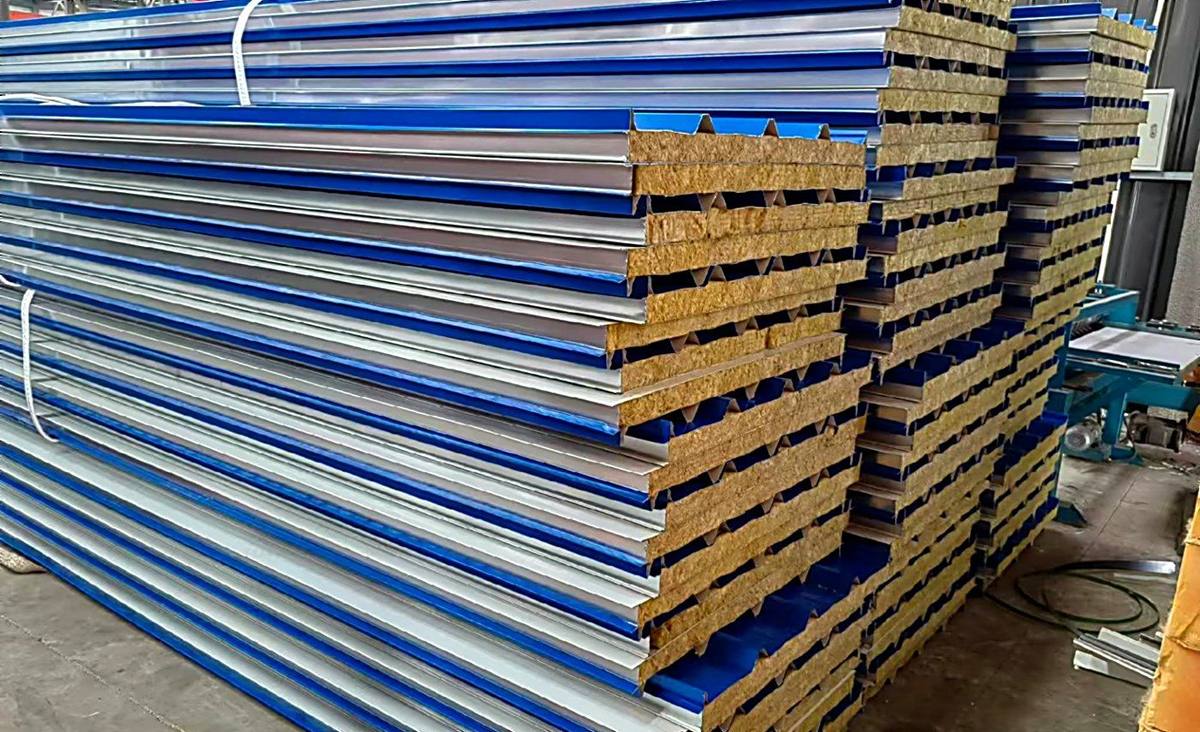
Sandwich Panel Core Comparison:
EPS vs Rock Wool vs PU, With the Numbers
Two panels with the same steel skin and the same thickness can differ in price by more than half, and in fire behaviour by an entire class. The core decides both.
Buyers ask for sandwich panels constantly and quote them rarely, because a panel is sold by the square metre and the core is buried inside. Two quotations for the same building can therefore describe completely different products — and the cheaper one is not automatically the better one.
Why the sandwich panel core decides your price, your insulation and your fire rating
A sandwich panel is two steel skins bonded to an insulating core. The skins carry the weather and the finish. The core insulates, holds the skins apart against wind suction, takes the compressive load between them, and decides how the panel behaves in a fire.
Cost follows from the same place. Foam cores are light and cheap per cubic metre; mineral wool cores are heavy and dearer. Since a panel is priced by area, the price gap between cores is decided by how much core each square metre needs — which is why thickness and core must be judged together.
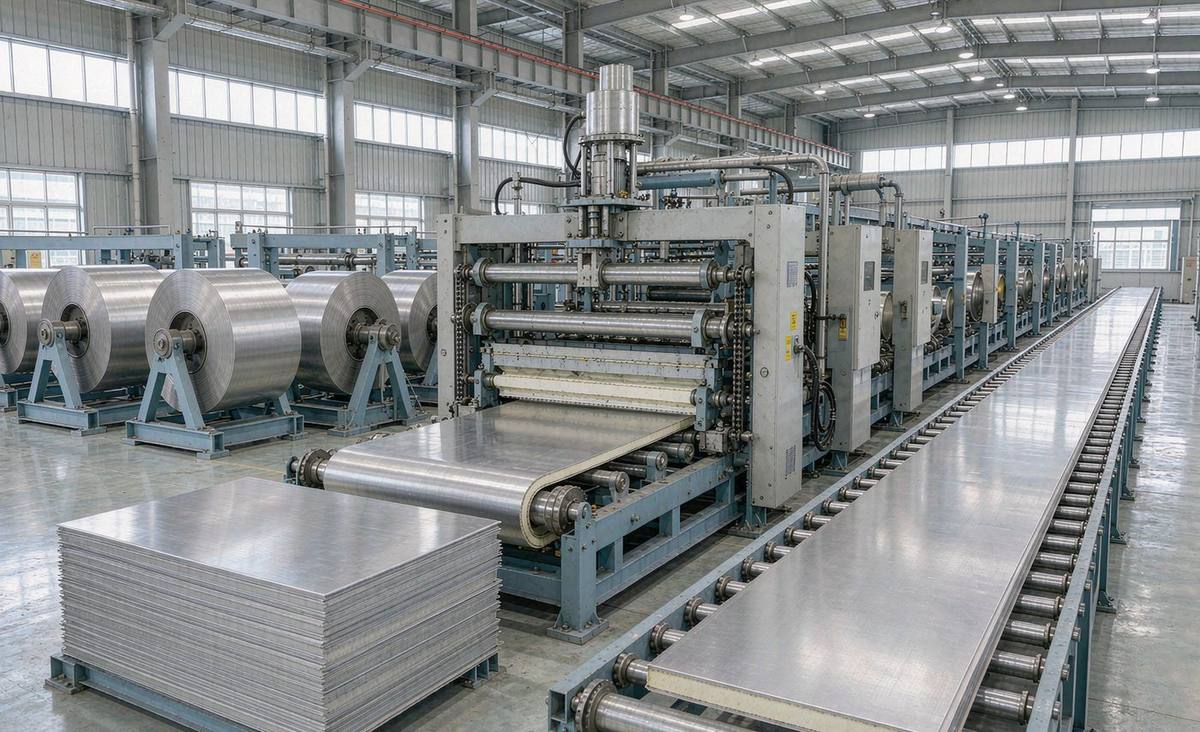
We run a continuous sandwich panel line in Foshan producing EPS, rock wool, glass wool and PU cores from 50 mm to 200 mm.
Sandwich panel core comparison: the five cores at a glance
Thermal conductivity decides insulation. Density decides how heavy the panel is and how much load it puts on your frame. Fire behaviour decides if the panel is permitted.
| Core | Thermal conductivity λ (W/m·K) | Density (kg/m³) | Fire behaviour (EN 13501-1) | Water and joint behaviour |
|---|---|---|---|---|
| EPS | 0.035 – 0.040 | 15 – 25 | E to B2 — combustible unless treated | Closed cell; light, easy to cut |
| Rock wool | 0.040 – 0.044 | 100 – 120 | A2-s1,d0 — non-combustible | Porous; joints must be sealed |
| Glass wool | 0.032 – 0.036 | 24 – 48 | A1 / A2 — non-combustible | Porous, light; excellent acoustics |
| PU | 0.022 – 0.026 | 38 – 42 | B-s2,d0 typically | Closed cell; stable, moisture resistant |
| PIR | 0.021 – 0.024 | 40 – 45 | B-s1,d0 typically — chars, slows flame | Closed cell; fire-enhanced PU alternative |
Indicative reference ranges for typical commercial panels. A fire classification belongs to the tested panel, not to the name of the foam — always request the test report for the product you buy.
Thermal performance by sandwich panel core: U-value and weight
Compare the U-value, not the thickness: this is the fastest way to see why two quotations can be priced differently and both be honest.
| Core | 50 mm | 75 mm | 100 mm | 150 mm |
|---|---|---|---|---|
| EPS | 0.64 / 7.0 | 0.44 / 7.4 | 0.34 / 7.8 | 0.23 / 8.5 |
| PU | 0.41 / 8.3 | 0.28 / 9.3 | 0.21 / 10.3 | 0.14 / 12.3 |
| Rock wool | 0.74 / 11.8 | 0.51 / 14.5 | 0.39 / 17.3 | 0.27 / 22.8 |
Each cell reads U-value / weight, for typical panels with 0.4 mm steel skins; U-values exclude joint and fixing effects. Note that 50 mm of PU insulates better than 75 mm of EPS. Final thickness and fixing must be confirmed by a structural engineer against your actual loads.
Which sandwich panel core should you specify for your building?
Start from the use of the space and the temperature you must hold inside, then work back to the core.
| Application | Core to specify | Typical thickness | Reason |
|---|---|---|---|
| Unconditioned warehouse, budget | EPS | 50 mm | Lowest cost, lightest |
| Air-conditioned warehouse or factory | PU or PIR | 75 – 100 mm | Controls the cooling load |
| Chiller or freezer room, +8 °C to −25 °C | PU or PIR | 75 – 150 mm | Best U-value per mm |
| Blast freezer, cold store | PU or PIR | up to 200 mm | Highest insulation duty |
| Fire-rated wall, fire zone separation | Rock wool | 80 – 150 mm | A2 core; 60 to 120 min tested |
| Generator or electrical room | Rock wool | 80 – 150 mm | Non-combustible |
| Workshop roof, noise next door | Glass wool or rock wool | 75 – 100 mm | Best sound insulation |
| Site office, annex, guard room | PU | 50 – 75 mm | Light, no heavy frame |
Two rules survive every project. Do not use EPS in a freezer — it has no useful performance at low temperature and the fire class is the wrong way to be. And do not switch core between roof and wall without checking the fixing, because rock wool is roughly 50 % heavier than PU of the same thickness.
Fire rating and what the sandwich panel core classification does not tell you
Rock wool and glass wool are non-combustible mineral fibres; their panels are typically A2-s1,d0 and A1, and tested wall systems can give 60 or 120 minutes of fire resistance depending on thickness. PU foam is combustible, but at B-s2,d0 it is self-extinguishing. PIR is the fire-enhanced version of PU: under flame the core chars, and that char slows flame spread.
One warning saves money: a classification belongs to the tested product, not to the name printed on a quotation. Ask for the fire test certificate for the exact panel — core, thickness, skins and joint system together — and check whether your code requires a specific class.
Roof panel span and purlin support by sandwich panel core thickness
For a self-supporting insulated roof panel, the panel spans between purlins, so the purlin spacing has to match the panel thickness and the load case. Thicker panels carry more load before deflecting, so they sit on wider spacing.
| Panel thickness | Indicative span between supports | Note |
|---|---|---|
| 40 mm | ≈ 3.0 m | Minimum practical roof thickness |
| 60 mm | ≈ 3.8 m | Common on unconditioned buildings |
| 100 mm | ≈ 4.8 m | Standard for insulated roofs |
| 120 mm | ≈ 5.0 m | Upper end of standard roof panels |
Indicative only, for standard profiles and normal uplift. The permitted span must be taken from the panel manufacturer’s load table for your site wind and deflection limit, and the final purlin spacing verified by a structural engineer. Standard purlin spacing is 1.2–1.5 m.
Frequently asked questions
PU or PIR. They give the best U-value per millimetre, resist moisture and stay stable at low temperature. Use 75–100 mm for chiller rooms, 120–150 mm for freezers down to −25 °C, and up to 200 mm for blast freezing.
EPS is a combustible foam, classified E to B2 unless treated, so it is not appropriate where a fire-rated wall is required. It suits unconditioned warehouses and site accommodation. Where fire matters, specify rock wool or PIR.
Within one core, yes. Across cores, no: a 50 mm PU panel has a U-value of about 0.41 W/m²K while a 75 mm EPS panel is about 0.44. Compare U-values, not thickness, and ask any supplier for theirs.
75–100 mm of PU or PIR is the usual starting point, then adjust for your climate, roof orientation and the running cost you will carry. The roof is usually the bigger heat load, so spend the thickness budget there first.
Yes, and it is common — PU or PIR on the roof, EPS on unconditioned walls, rock wool on fire-rated walls, PU in the cold room. Check the purlin spacing and fixings for the heaviest core on that run.
Send the panel specification, get a comparable quotation
Tell us the areas, core, thickness, joint system and delivery point — or just the building size and use, and we will propose the core and thickness with the U-values and weights alongside the price. Reply within 24 hours.
Related guides
Steel structure shipping container
Container sizes, payload limits, packing rules and a worked 1,000 m² count.
Read the guideHow to quote a steel building
The RFQ checklist and what a complete quotation must contain.
Read the guideColor steel sheet thickness: 0.5, 0.6 or 0.8 mm
Base metal vs total thickness, tolerance bands and real section properties.
Read the guideRoof and wall sheet range
Every colour steel profile we roll, with the thicknesses available.
See the sheet rangeC purlin vs Z purlin: which to specify?
How section shape decides your span, tonnage and fixings.
Read the guideHow much does a steel building cost per m²?
The seven cost blocks behind any steel building price.
Read the guideTechnical FAQ
Thirteen straight answers on cost, grades, loads and export.
Read the FAQPurlin span calculator
Panel span and purlin spacing are set together — check both before you fix either.
Open the calculator